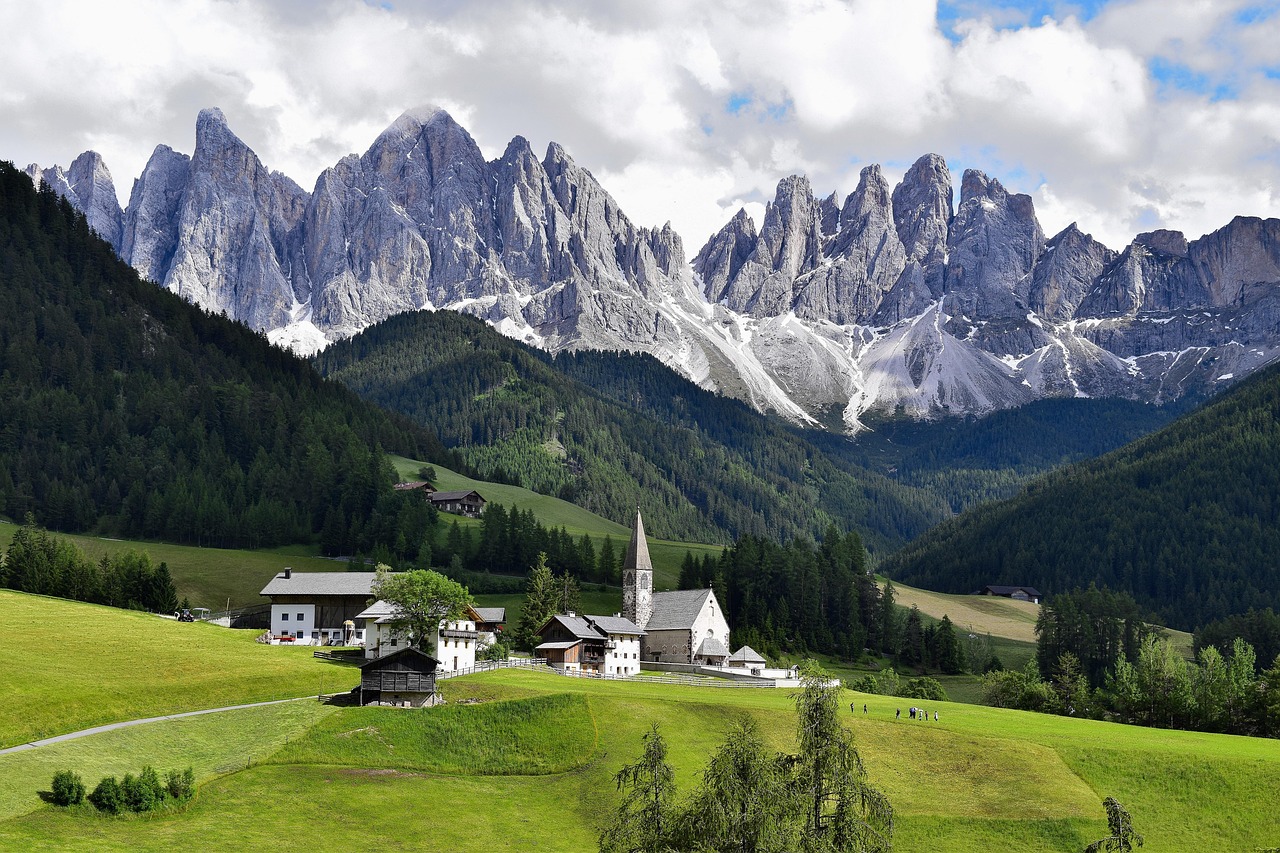
People often ask us how the Dolomites compare to other mountain ranges — the Rockies, the Alps in Switzerland or France, Patagonia. The honest answer is that they don't really compare. The Dolomites are their own thing entirely, and once you've seen them, you understand why UNESCO designated them a World Heritage Site.
Here's what makes them so different.
The Rock
The Dolomites are named after the mineral dolomite — a type of carbonate rock that gives these mountains their distinctive pale, almost white appearance. While most mountain ranges are dark granite or volcanic rock, the Dolomites look like they've been carved from bone. The towers, spires, and walls are vertical and dramatic in a way that defies what you think mountains should look like.
And then there's the light. At sunrise and sunset, the dolomite rock catches the sun and turns shades of pink, orange, and deep red. The Italians call this phenomenon enrosadira — and seeing it for the first time is one of those moments you never forget. The mountains literally glow.
Above Treeline, All Day
In many mountain ranges, you spend hours hiking through forest before you reach the views. In the Dolomites, most of our trails are above treeline from the start. That means you're walking through wide-open alpine meadows with 360-degree panoramas of towers, walls, and valleys stretching to the horizon.
The scale is hard to describe. You'll turn a corner on the trail and suddenly be face-to-face with a 3,000-foot vertical wall of pale rock. Then you'll cross a high pass and see an entirely new valley system unfold below you. It just keeps going.
The Culture at the Crossroads
The Dolomites sit in northeastern Italy, in a region that was part of the Austro-Hungarian Empire until World War I. The result is a culture that's uniquely blended — Italian and Austrian, Mediterranean and Alpine. You'll hear Italian and German spoken side by side. The food mixes pasta and polenta with schnitzel and strudel. The architecture shifts from Italian stone to Tyrolean wood depending on which valley you're in.
This isn't a monoculture. It's a place where two traditions have intertwined over centuries, and the richness of that blend shows up in everything from the food to the music to the way people greet each other on the trail.
The Hut System
Switzerland and France have mountain huts, but the Italian rifugio system is something else. These aren't bare-bones shelters — they're full-service mountain lodges with hot meals, wine, espresso, and real beds. Many have been run by the same families for generations. The hospitality is genuine and warm in a way that feels distinctly Italian.
The hut system also means the mountains are accessible without being a mountaineer. A well-marked trail network connects rifugio to rifugio, and because you can eat and sleep at each one, you don't need to be an expedition-level hiker to spend a week in the high mountains. It democratizes the alpine experience in the best possible way.
The History
The Dolomites were a major front in World War I, and evidence of the conflict is everywhere — tunnels carved through peaks, trenches cut into ridgelines, rusted cable anchors, and old military roads that are now hiking trails. On our Day 6 hike near Tre Cime di Lavaredo, you walk past Austrian dugouts and Italian positions that were active over a hundred years ago.
It adds a gravity to the landscape that you won't find in most hiking destinations. These mountains aren't just beautiful — they carry the weight of history.
The Feeling
This is the hardest thing to explain, but it's the most important. There's a feeling you get in the Dolomites that's different from anywhere else. Maybe it's the scale of the rock against the delicacy of the wildflowers. Maybe it's the silence at 2,800 meters. Maybe it's sitting outside a rifugio after dinner, watching the towers turn pink, with a glass of wine in your hand and the satisfaction of a hard day's walk in your legs.
Whatever it is, it stays with you long after you come home.
We've been coming to these mountains our whole lives, and they still take our breath away. That's how you know a place is special.
Ready to Hit the Trail?
Join us for a 6-day adventure through the Italian Dolomites
Reserve Your Spot